
Small Claims Court and Security Deposits: When It’s Worth It (and Why Landlords Pay Before Court)
1/8/202622 min read

Small Claims Court and Security Deposits: When It’s Worth It (and Why Landlords Pay Before Court)
You didn’t “lose” your security deposit.
It was taken.
And the moment you realize that—when your landlord stops answering emails, sends you a vague invoice, or simply ghosts you after move-out—something visceral happens in your chest. Anger. Betrayal. Panic. That money was yours. You earned it. You protected the apartment. You followed the rules. And now it’s being held hostage by someone who knows you’re tired, busy, and probably afraid of legal action.
That’s exactly why small claims court exists.
Not to create drama.
Not to turn tenants into litigators.
But to give ordinary people a weapon that forces accountability.
And here’s the truth most landlords don’t want you to know:
The moment you file a small claims case over your security deposit, the power dynamic flips.
Landlords stop bluffing.
Excuses evaporate.
Checks suddenly get mailed.
Because small claims court is not about who has the best lawyer.
It’s about who has the facts, the timeline, and the courage to press “file.”
This guide will show you exactly when small claims court is worth it, how it works, why it terrifies landlords, and how to use it as leverage to get paid—often without ever stepping into a courtroom.
Why Security Deposits Are the Most Common Small Claims Case in America
Every year in the United States, hundreds of thousands of small claims cases are filed over one thing:
Unreturned security deposits.
Not car accidents.
Not broken contracts.
Not unpaid loans.
Security deposits.
Why?
Because the landlord-tenant relationship creates a perfect storm for abuse:
Landlords control the money
Tenants leave town
Evidence gets lost
Deadlines get ignored
And most tenants don’t know their rights
Security deposit laws are some of the most tenant-friendly statutes in U.S. law. They are designed to punish landlords who play games with other people’s money.
But those laws only work if someone enforces them.
And that someone is you.
What Small Claims Court Actually Is (And What It Isn’t)
Small claims court is not “real court” in the way people imagine.
You do not need a lawyer.
You do not file complex motions.
You do not argue legal theory.
You tell a judge what happened.
You show your evidence.
The judge applies the law.
A decision is made.
That’s it.
Most security deposit small claims hearings last 10 to 20 minutes.
And in those 10 minutes, a landlord who has been ignoring you for months can be ordered to pay:
The full deposit
Plus interest
Plus statutory penalties
Plus court costs
Sometimes double or triple damages
That’s why they settle.
The Psychological War Behind Every Deposit Dispute
When a landlord keeps your deposit, they are not relying on the law.
They are relying on you giving up.
They assume:
You moved on
You’re too busy
You don’t want stress
You don’t understand the rules
You’re afraid of court
Small claims court destroys all of that.
It sends one devastating message:
“I am not bluffing.”
And that message is worth thousands of dollars.
When Small Claims Court Is Absolutely Worth It
Let’s get brutally honest.
You should not go to small claims court for every deposit dispute.
But you absolutely should when any of the following are true.
1. The Legal Deadline Has Passed
Every state sets a strict deadline for landlords to return your deposit or send an itemized deduction list.
Common deadlines:
14 days
21 days
30 days
If that deadline passes without full compliance, the landlord is automatically in violation of the law.
In many states, that alone entitles you to statutory damages—often double or triple the deposit.
No damage needed.
No argument required.
Just math.
That’s small claims gold.
2. You Received a Fake or Inflated Deduction List
Landlords often send:
Vague charges (“cleaning”)
Made-up repairs
Normal wear and tear
No invoices
No proof
Or charges for things that were already damaged
That is illegal.
Security deposit deductions must be:
Specific
Reasonable
Documented
For actual damage beyond normal wear and tear
If your landlord didn’t follow those rules, a judge will see right through it.
3. The Amount Is Meaningful to You
If your deposit was:
$500
$1,000
$2,500
$5,000
That’s real money.
Small claims court costs $30–$150 to file.
Return on investment is enormous.
4. The Landlord Is Stonewalling
When emails go unanswered
When calls go to voicemail
When you get “we’re still reviewing” for weeks
That’s not delay.
That’s strategy.
Small claims court cuts through it instantly.
When It Might Not Be Worth It
There are rare situations where court may not be the best first move:
The deposit is under $200
The landlord already paid most of it
You caused obvious major damage
You didn’t provide a forwarding address
But even then, the threat of court often works.
Why Landlords Fear Small Claims Court More Than Lawyers
This surprises most tenants.
Landlords are not afraid of tenant lawyers.
They are afraid of judges.
Here’s why.
Lawyers Are Negotiable
Judges Are Not
A lawyer can be delayed, argued with, negotiated.
A judge issues orders.
And those orders are enforceable by law.
Judges Apply Statutory Penalties
Most landlords don’t just owe the deposit.
They owe:
Penalty damages
Interest
Court costs
Sometimes attorney fees
One missed deadline can triple their liability.
Judges Hate Deposit Abuse
Security deposit laws exist because of systemic abuse.
Judges see these cases every week.
They know the tricks.
They do not have patience for them.
The Moment the Power Shifts: Filing the Case
The single most powerful thing you can do is file.
Not threaten.
Not email.
Not negotiate.
File.
The moment the landlord is served with court papers, several things happen:
Their risk jumps
Their lawyer gets involved
Their insurance company gets notified
Their accounting department panics
Now they are spending time and money.
Now it’s cheaper to pay you.
How a Typical Security Deposit Case Unfolds
Here is what happens in the real world, step by step.
Step 1: Tenant Sends Demand Letter
You send a written demand:
Amount owed
Legal deadline missed
Time to pay
This creates a paper trail.
Step 2: Landlord Ignores or Denies
They:
Stall
Offer partial payment
Blame damage
Or go silent
Step 3: You File Small Claims
You file:
Defendant name
Property address
Amount claimed
Reason: unlawful withholding of security deposit
Step 4: Landlord Is Served
This is the shock.
Now it’s real.
Step 5: You Get a Settlement Offer
In most cases, this happens before court.
Often:
Full deposit
Plus filing fee
Sometimes interest
Why?
Because landlords know their odds.
Real Example: $1,800 Becomes $5,400
In California, a tenant’s $1,800 deposit was withheld.
The landlord missed the 21-day deadline.
The tenant filed small claims for:
$1,800 deposit
$3,600 penalty (2×)
$75 filing fee
Total: $5,475
The landlord paid $1,800 before court.
The tenant refused.
The judge awarded the full $5,475.
That is how small claims court changes lives.
What You Need to Win
You do not need perfection.
You need three things.
1. Proof of Payment
Lease
Receipt
Bank statement
2. Proof of Move-Out Date
Lease end
Keys returned
Email confirmation
3. Proof of Deadline Violation or Bad Deductions
Envelope with postmark
No itemized list
Inflated charges
No invoices
That’s it.
Why Even Bad Tenants Win Deposit Cases
You don’t have to be perfect.
You don’t have to be clean.
You don’t have to be nice.
You only have to show the landlord violated the statute.
Judges don’t reward bad behavior—but they punish illegal behavior.
And most deposit withholding is illegal.
How Landlords Try to Scare You Out of Court
You may hear:
“We’ll countersue you”
“You damaged the unit”
“We’ll send it to collections”
“We’ll ruin your credit”
In small claims court, those threats are mostly meaningless.
They must prove everything.
And they usually can’t.
What Happens If You Win
If the judge rules in your favor:
You get a judgment
The landlord must pay
If they don’t, you can:
Garnish bank accounts
Place liens
Levy property
Landlords know this.
That’s why they pay.
The Hidden Secret: You Rarely Need to Go to Court
The mere act of filing is often enough.
It signals:
You know the law
You are serious
You won’t disappear
Most landlords settle because they know the math.
Why Small Claims Court Is One of the Best Financial Decisions You’ll Ever Make
Where else can you invest:
$50
One afternoon
Basic paperwork
And potentially recover:
$1,000
$3,000
$10,000
With the law on your side?
This is not revenge.
This is justice with a return on investment.
The Emotional Payoff No One Talks About
Winning your deposit back is not just money.
It’s closure.
It’s dignity.
It’s knowing someone can’t steal from you and get away with it.
And that feeling lasts longer than any check.
The Final Truth About Small Claims and Security Deposits
Landlords do not pay because they are kind.
They pay because:
The law is strict
Judges are unforgiving
And tenants who file win
Small claims court is not a threat.
It is a lever.
And when you pull it, money moves.
Your Next Step (This Is Where Most People Freeze)
You can keep hoping.
You can keep emailing.
You can keep waiting.
Or you can do the one thing that changes everything:
Start the legal clock.
That means:
Demand letter
Deadline
Filing
If you want the exact scripts, templates, and step-by-step system used by tenants who get paid without hiring lawyers, that’s exactly what our Security Deposit Recovery Guide gives you.
It shows you:
What to send
When to send it
How to file
How to pressure
How to win
And it costs less than what your landlord already took from you.
If you’re serious about getting your money back, don’t guess.
Get the playbook.
continue
…because guessing is what landlords are counting on.
And once you move past that hesitation—once you decide that you are not going to let someone else profit from your fear or your exhaustion—the entire dynamic of your security-deposit fight changes. You stop being a former tenant begging for what is already yours and you become a claimant asserting a legal right that the court system is built to enforce.
That shift is the real power of small claims court, and it’s why landlords who act invincible over email suddenly become cooperative the moment a clerk stamps your filing.
Now let’s go deeper, because if you are going to use small claims court strategically, you need to understand not just what it is, but how landlords think about it, how they price risk, and how they decide whether to fight you or pay you.
How Landlords Calculate Whether to Fight or Pay
When a landlord receives a small claims summons over a security deposit, they don’t think emotionally. They think in numbers.
They ask themselves three questions:
What is my maximum legal exposure?
How likely am I to lose?
What will it cost me to defend this?
Those three numbers almost always add up to one conclusion: it’s cheaper to pay the tenant.
Let’s break that down with a realistic example.
Imagine you paid a $2,000 security deposit. You moved out. The landlord missed the statutory deadline to return it or send a proper itemized list.
In a state like California, New York, Massachusetts, or many others, that one mistake exposes the landlord to:
The full $2,000 deposit
Plus up to $4,000 in penalties (double damages)
Plus court costs
Plus interest
Suddenly a $2,000 dispute is a $6,000–$7,000 legal risk.
Now add defense costs.
Even if the landlord handles it in-house, they still have:
Staff time
Record gathering
Court appearances
Possible attorney review
That might easily be another $500–$2,000.
Now the risk looks like this:
“I can pay the tenant $2,000 now, or I can risk paying $7,000 later and spend weeks dealing with court.”
That is why so many landlords mail checks after filing but before the hearing.
They aren’t being generous.
They’re being rational.
Why Your Case Is Stronger Than You Think
Most tenants underestimate their own leverage because they focus on the condition of the apartment.
They think:
“The carpet was a little worn.”
“The walls had a few marks.”
“The landlord had to clean.”
That’s not what wins or loses deposit cases.
Procedure wins deposit cases.
Deadlines.
Documentation.
Proper notice.
Itemization.
Proof.
If the landlord violated any of those, it doesn’t matter if the unit was spotless or messy. The law punishes the violation.
That’s why you will often see judges rule for tenants even when there was some damage, simply because the landlord failed to follow the statute.
The legal system is not grading your housekeeping.
It is grading the landlord’s compliance.
The “They’ll Counter-Sue You” Myth
One of the biggest fears tenants have is that filing small claims will somehow backfire.
They imagine:
The landlord suing for thousands
Collections destroying their credit
Endless legal battles
In reality, this almost never happens in deposit cases.
Why?
Because landlords don’t want to open their own books.
If they countersue, they must:
Prove the damage
Prove the cost
Prove it wasn’t normal wear and tear
Prove they complied with the deposit law
That is exactly what they are trying to avoid.
Most landlords who withhold deposits do it because they are hoping you won’t force them to prove anything.
Small claims court forces proof.
And that’s dangerous for them.
What Judges Actually Look For in Deposit Cases
When you walk into a small claims courtroom with a security deposit dispute, the judge is not looking for drama.
They are looking for a timeline.
They want to know:
When did you move out?
When did the landlord receive possession?
When did the landlord send the deposit or deductions?
What exactly was sent?
Was it compliant with the law?
That’s it.
If the answers show a violation, the judge will rule for you.
That’s why you don’t need to be a legal expert. You need to be organized.
The Simple Timeline That Wins Cases
Here is the timeline that wins more deposit cases than anything else.
Move-out date: March 31
Deadline under state law: April 21
Landlord response: May 5, vague deductions, no receipts
That timeline alone can win.
The judge sees:
Late
Incomplete
Non-compliant
And that is usually enough.
Why “Normal Wear and Tear” Is So Powerful
One of the most abused concepts in landlord-tenant law is wear and tear.
Landlords often try to charge tenants for:
Faded paint
Worn carpet
Minor scuffs
Old appliances
Those are not deductible.
They are the cost of doing business.
Judges know this.
And when landlords try to pass normal aging onto tenants, they lose credibility fast.
In small claims court, credibility matters.
How Filing Changes the Landlord’s Behavior Overnight
Tenants are always shocked by what happens after they file.
Before filing:
No replies
Delays
Excuses
Indifference
After filing:
Emails within hours
Phone calls
“Let’s work something out”
Settlement offers
Why?
Because now the landlord is no longer dealing with you.
They are dealing with a judge.
And judges don’t negotiate.
The Settlement Dance
Here is how it usually goes.
You file.
The landlord is served.
Within days, you get an email or call.
They might say:
“We believe our deductions were valid, but to avoid the inconvenience of court, we are willing to refund $1,200.”
That is a test.
They are probing whether you know your leverage.
If you accept, they saved thousands.
If you decline and stick to your legal claim, the number usually goes up.
This is why understanding the law is money.
Why Even Partial Payments Are Dangerous for Landlords
In many states, if a landlord sends a partial deposit without a proper itemization, it can actually increase their liability.
Because it proves:
They had the money
They chose not to comply
Judges take that seriously.
So when a landlord offers you a partial payment after you file, it’s often a sign they know they are in trouble.
The Myth of “Going to Court Is a Hassle”
Yes, you might have to take a morning off work.
Yes, you might have to organize some documents.
But compare that to losing:
$1,000
$2,500
$5,000
Because you didn’t want to show up for 20 minutes.
That’s not convenience.
That’s surrender.
What Happens in the Courtroom
If you do go to court, it is nothing like TV.
You don’t stand in front of a jury.
You don’t cross-examine witnesses dramatically.
You and the landlord sit at tables.
The judge asks questions.
You answer.
You show papers.
That’s it.
Most judges in small claims are polite, direct, and efficient.
They’ve seen every trick.
And they usually appreciate tenants who come prepared.
How to Present Your Case in 5 Minutes
You don’t need speeches.
You need structure.
A simple way to present your case is:
“Your Honor, I paid a $2,000 security deposit. I moved out on March 31. Under state law, the landlord had 21 days to return it or provide a proper itemized list. They did not. They sent me a vague statement on May 5 with no receipts. I am asking for the return of my deposit and statutory damages as provided by law.”
That’s enough.
Everything else is backup.
Why Judges Often Award Penalties
Many tenants are afraid to ask for penalty damages.
They think it looks greedy.
It doesn’t.
It looks informed.
Those penalties exist to stop abuse.
When a landlord ignores the law, judges use those penalties to send a message.
That message is:
“Follow the rules or pay the price.”
And when judges send that message, landlords listen.
The Long-Term Effect on the Landlord
Winning a deposit case does more than get you paid.
It creates a record.
Landlords who lose deposit cases:
Get flagged internally
Get warned by attorneys
Change behavior
They stop playing games.
You are not just getting your money back.
You are making it harder for them to steal from the next tenant.
Why This Is Bigger Than You
Most tenants think their deposit dispute is small.
It isn’t.
It is part of a national pattern of abuse.
Security deposits represent billions of dollars sitting in landlord accounts.
And every time a tenant doesn’t fight, that system is rewarded.
Small claims court is one of the few tools that actually shifts that balance.
The Cost of Doing Nothing
Let’s be honest about the alternative.
If you don’t file:
The landlord keeps your money
They learn it works
You feel cheated
You move on with resentment
And nothing changes.
If you do file:
You might get paid
You might get more than your deposit
You reclaim control
You close the chapter with dignity
There is no downside.
The Emotional Side of Filing
People think filing a case is aggressive.
It’s not.
It’s self-respect.
It’s saying:
“I won’t let someone take from me just because they think I’m powerless.”
That mindset doesn’t just win deposit cases.
It changes how you walk through the world.
Why Most Tenants Who File Say They Would Do It Again
Ask anyone who has taken a landlord to small claims court.
They will tell you the same thing:
“I wish I had done it sooner.”
Because once you see how simple it is, you realize how much fear was unnecessary.
The Step Everyone Skips That Makes Filing Easy
Before you file, you should always send a final written demand.
Not because the landlord deserves it.
But because judges love it.
It shows:
You tried to resolve it
You gave notice
You were reasonable
And when the landlord ignores it, they look bad.
Very bad.
Why Landlords Sometimes Pay the Day Before Court
This happens all the time.
You prepare.
You print documents.
You plan to go.
Then the night before, you get a message:
“We will be mailing you a check for the full amount. Please dismiss the case.”
That’s victory.
That’s the system working.
And it only happens because you were willing to go all the way.
The Hidden Truth: Small Claims Court Is One of the Best Consumer Protection Tools in America
It’s fast.
It’s cheap.
It’s accessible.
And it works.
For security deposits, it is almost perfectly designed.
Because the law is clear, the stakes are high, and the violations are easy to prove.
The Final Decision You Have to Make
You already know what happened.
You already know whether your landlord played fair.
The only question left is whether you are going to let it go.
Or whether you are going to do the one thing that makes landlords respect you:
File.
And if you want to do it the smart way—without guessing, without missing deadlines, without leaving money on the table—our Security Deposit Recovery Guide walks you through every step.
Demand letters.
Deadlines.
Filing.
Settlement pressure.
Court strategy.
It’s the same system thousands of tenants have used to turn silence into checks.
If your landlord is counting on you to give up, don’t.
Get the guide.
Use the system.
Get your money back.
And if you’re still reading this, it means you’re closer than you think.
Because the hardest part isn’t filling out a form.
It’s deciding you’re worth fighting for.
continue
…and once you make that decision—once you accept that your time, your money, and your dignity matter enough to press forward—the rest becomes almost mechanical. That’s one of the most powerful and least understood truths about small claims court in security-deposit cases: the law does most of the work for you. You are not inventing a fight. You are simply stepping into a process that was built precisely for this situation.
Now let’s go even deeper, because the more you understand how the system works behind the scenes, the more confident and dangerous you become to any landlord who thought you were an easy mark.
The Hidden Architecture of Security Deposit Laws
Most tenants think security deposit laws are vague guidelines. They are not. They are among the most rigid consumer-protection statutes in the United States.
Legislatures made them rigid on purpose.
Why? Because for decades landlords abused the ambiguity. They invented charges, delayed refunds, and relied on tenants moving away or giving up. Lawmakers responded by turning deposits into something very close to trust funds—money that is temporarily held, not owned.
That’s why these laws focus obsessively on:
Deadlines
Written notice
Itemization
Receipts
Delivery methods
When a landlord breaks any of those rules, they are no longer just “late.” They are in statutory violation.
And statutory violations are what judges punish.
Why “Good Faith” Doesn’t Save a Landlord
Landlords often defend themselves by saying:
“We acted in good faith.”
“We were just busy.”
“We made a mistake.”
In security deposit law, that usually does not matter.
The statutes are strict liability.
That means:
Either they complied
Or they didn’t
Intent is irrelevant.
A missed deadline is a missed deadline.
That is why small claims court is so dangerous for landlords. They cannot talk their way out of a calendar.
The Paper Trail That Wins
One of the reasons tenants win so often is that deposit disputes leave a paper trail.
You have:
A lease
A move-out date
A deposit amount
Emails
Checks
Postmarks
The landlord also has records.
The judge compares the two.
And if the landlord’s story doesn’t match the timeline, the tenant wins.
It’s not about storytelling.
It’s about documentation.
Why Filing Is So Simple (On Purpose)
Small claims court was designed to be used by ordinary people.
That’s why:
Forms are simple
Filing is cheap
Instructions are public
Clerks help you
You are not expected to know the law.
You are expected to know what happened.
And that is enough.
The Moment the Landlord’s Tone Changes
Almost every tenant reports the same emotional shift.
Before filing, the landlord is dismissive, slow, or rude.
After filing, they become polite, professional, and suddenly eager to “resolve things.”
That’s not coincidence.
That’s fear.
Because now the landlord is no longer dealing with someone they can ignore.
They are dealing with a court order.
Why Property Managers Panic Faster Than Individual Landlords
Large property management companies are especially sensitive to small claims filings.
Why?
Because:
They have many tenants
They have compliance departments
They have lawyers who track risk
A single small claims case is not just one dispute.
It’s a red flag.
It signals:
A possible pattern
A regulatory risk
A compliance failure
So when you file against a big landlord, you often get paid even faster.
They don’t want the spotlight.
The “We’ll Send It to Collections” Bluff
One of the nastiest tactics landlords use is to threaten collections.
They say:
“You owe us money. We’ll send it to collections if you don’t pay.”
In a deposit dispute, this is usually a bluff.
Why?
Because:
They must prove the debt
You can dispute it
A pending court case blocks collection
And if they are wrong, they expose themselves to additional liability.
Judges hate abusive collections tactics tied to illegal deposit withholding.
It makes landlords look predatory.
What If the Landlord Doesn’t Show Up?
This happens more than you think.
Landlords assume tenants won’t show.
Then they get busy.
Then they forget.
Then the hearing happens.
If the landlord does not appear, you usually win by default.
The judge hears your side.
Sees your documents.
Enters judgment.
That’s it.
The Power of a Judgment
A small claims judgment is not a suggestion.
It is a legal order.
If the landlord does not pay, you can:
Garnish bank accounts
Levy business funds
Place liens on property
Report the judgment
Landlords know this.
They may delay.
They may complain.
But they usually pay.
Because a judgment follows them.
Why Judges Often Believe Tenants Over Landlords
This surprises people.
Judges see hundreds of deposit cases.
They know:
Tenants usually just want their money
Landlords often play games
When a tenant shows up organized, calm, and factual, and a landlord shows up defensive or vague, credibility shifts.
And credibility decides cases.
How to Use Small Claims Court as Leverage Without Even Going
One of the smartest strategies is to use filing as a negotiating tool.
Here’s how it works:
You send a final demand letter
You wait the required time
You file
You tell the landlord the case number
That alone often triggers payment.
You don’t have to threaten.
The docket speaks for you.
The Dirty Secret of Deposit Deductions
Many landlords don’t even have real invoices.
They:
Guess
Estimate
Or make it up
When they get to court, they can’t prove anything.
And without proof, they lose.
That’s why they settle.
Why You Should Never Feel Guilty
Some tenants hesitate because they think:
“Maybe the landlord really did have to fix things.”
That may be true.
But the law already accounts for that.
It allows reasonable, documented deductions.
What it does not allow is:
Sloppiness
Delay
Or abuse
When a landlord violates the law, they created the problem.
Not you.
The “It’s Not Worth My Time” Trap
This is the final psychological barrier.
Landlords count on it.
They know:
You’re busy
You moved
You want closure
So they drag it out.
Small claims court collapses that strategy.
It puts a hard deadline on the dispute.
And deadlines create results.
Why So Many Tenants Walk Away Richer Than They Expected
Because of penalty damages, many tenants recover more than their original deposit.
That is not luck.
That is the law working as designed.
It rewards people who assert their rights.
The Long-Term Impact on Your Financial Confidence
Once you win a deposit case, something changes.
You realize:
You can stand up to institutions
You can use the law
You are not powerless
That confidence spills into everything else.
The One Mistake That Weakens Cases
The biggest mistake tenants make is waiting too long.
Statutes of limitation apply.
Deadlines matter.
The sooner you act, the stronger your position.
Why Even Losing Can Be Worth It
Even in rare cases where tenants lose, they often get:
Partial payment
A settlement
Or clarity
What they don’t get is the feeling of being robbed.
That alone is worth something.
The Real Choice in Front of You
You can:
Let it go
Or let the system work
Small claims court is not extreme.
It is normal.
It is how millions of Americans recover money every year.
Where Most Tenants Stop — and Where You Shouldn’t
Most tenants stop at complaining.
They vent to friends.
They write angry emails.
They give up.
The tenants who get paid do one thing differently.
They file.
And That Brings Us Back to You
If you are reading this, it’s because something feels unfinished.
You know your landlord didn’t play fair.
You know the money matters.
And you know you deserve better than silence.
You don’t need a lawyer.
You don’t need luck.
You need a plan.
And if you want the exact letters, timelines, and filing strategy that turns deposit disputes into payments, that’s what the Security Deposit Recovery Guide gives you.
It shows you how to:
Demand correctly
Document properly
File confidently
Pressure legally
And win
This isn’t theory.
It’s the same system thousands of tenants use to go from “ignored” to “paid.”
Don’t let someone else keep what’s yours.
Get the guide.
Use the system.
And close this chapter the right way.
continue
…because closing the chapter the right way is not about revenge, and it’s not about being difficult. It’s about restoring balance. You paid a deposit in good faith. You held up your end of the lease. You gave possession back. The law says that money should come home to you. When it doesn’t, small claims court exists to make sure it does.
Now let’s talk about something that almost no one explains, but that makes a massive difference in how fast and how fully you get paid: how to frame your claim so that the landlord sees maximum risk from the very first line of the lawsuit.
Why the Way You File Your Case Changes Everything
Most tenants think filing small claims is just filling out a form.
Technically, that’s true.
Strategically, it’s much more than that.
The way you describe your claim determines:
How seriously the landlord takes it
Whether their lawyer gets involved
Whether they panic
Whether they settle quickly
Whether they try to fight
There is a world of difference between writing:
“Landlord owes me my security deposit”
and writing:
“Defendant violated state security deposit law by failing to return Plaintiff’s $2,000 security deposit or provide a legally compliant itemized statement within the statutory deadline, entitling Plaintiff to the deposit plus statutory penalties.”
Those two sentences create very different reactions.
One sounds like a complaint.
The other sounds like a lawsuit.
Landlords pay lawsuits.
Why “Statutory Penalties” Is a Magic Phrase
When you include the phrase “statutory penalties” in your claim, you are signaling something very important:
You know the law.
You know the risk.
You are not just asking nicely.
Most landlords immediately understand that this is no longer about a few hundred dollars.
It’s about potentially double or triple damages.
That changes the math.
How Landlords Read Your Filing
When a landlord receives a small claims filing, it is usually reviewed by:
A property manager
A supervisor
Sometimes an attorney
They scan for keywords:
“Statute”
“Deadline”
“Penalty”
“Bad faith”
“Failure to comply”
If those words are there, your case gets escalated.
Escalation means settlement discussions start.
Why You Should Always Ask for the Maximum Allowed by Law
Some tenants feel uncomfortable asking for penalties.
They think:
“I only want my deposit back.”
That’s understandable, but it’s not strategic.
When you ask only for the deposit, the landlord’s risk is low.
When you ask for the deposit plus penalties, their risk is high.
And high risk leads to payment.
Judges will not give you more than the law allows.
So asking for the maximum does not make you greedy.
It makes you prepared.
The Leverage of Uncertainty
One of the most powerful things about statutory penalties is that they introduce uncertainty.
Even if a landlord thinks they might win, they also know they might lose big.
That uncertainty is expensive.
So they pay to make it go away.
The Settlement Math in the Landlord’s Head
Let’s say your deposit was $1,500.
Penalties could be another $3,000.
Total risk: $4,500.
You file for $4,500.
The landlord might offer you $2,000 or $2,500.
That is more than your deposit.
You win.
They avoid court.
Everyone saves time.
That is how this system is supposed to work.
Why Judges Respect Tenants Who Know the Law
You don’t need to quote case law.
But when you reference the statute, deadlines, and penalties, judges see you as credible.
Credibility matters.
It makes your story easier to believe.
The Role of Bad Faith
In many states, landlords who act in “bad faith” are punished more severely.
Bad faith can include:
Ignoring deadlines
Making up charges
Refusing to communicate
Withholding without cause
When you describe these facts in your filing, you are laying the groundwork for higher damages.
Even if the judge doesn’t use the phrase “bad faith,” the concept matters.
Why Most Landlords Don’t Want a Judge to Decide
Landlords prefer to control outcomes.
Judges remove control.
They:
Look at evidence
Apply statutes
And issue orders
Landlords hate that.
So they settle.
The Strategic Value of Being Calm and Professional
One of the biggest mistakes tenants make is sounding angry.
Anger feels justified, but it weakens your position.
Professional, factual language is terrifying to landlords.
It means you are serious.
How to Use Time Against the Landlord
Landlords often delay because time usually works in their favor.
Small claims court reverses that.
Once you file, there is a court date.
Now delay hurts them.
That’s another reason they pay.
Why Corporate Landlords Often Settle Faster
Large landlords have:
Policies
Legal budgets
Risk thresholds
A small claims case triggers those systems.
And those systems often say:
“Pay it and move on.”
That’s why tenants who go up against big companies often get quick checks.
The Fear of Precedent
Landlords worry that if one tenant wins, others will follow.
They don’t want to create a pattern.
So they quietly settle.
The Myth That Judges Are Anti-Landlord
Judges are not anti-landlord.
They are anti-illegal.
When a landlord breaks a clear rule, judges enforce it.
That’s fairness.
Why You Don’t Need to Prove Malice
You don’t have to show the landlord was evil.
You only have to show they didn’t comply.
That’s a much easier standard.
The Hidden Advantage Tenants Have
Tenants come to court with:
A simple story
A small number of documents
A clear law
Landlords come with:
Complex excuses
Accounting records
And risk
Simplicity wins.
Why This Process Works So Well for Security Deposits
Security deposit cases are perfect for small claims court because:
The amounts fit within limits
The law is strict
The evidence is straightforward
And the penalties are real
It is one of the rare areas where the average person has a real advantage.
The Final Emotional Hurdle
The last thing holding most tenants back is fear.
Fear of confrontation.
Fear of paperwork.
Fear of the unknown.
Once you file, that fear disappears.
Because now you are no longer wondering what will happen.
You are making something happen.
And That’s Why Landlords Pay
They don’t pay because they suddenly respect you.
They pay because you forced them into a system that does not tolerate their games.
Small claims court is not a threat.
It is a mechanism.
And when you activate it, money moves.
If You Want to Do This the Smart Way
You can piece this together yourself.
Or you can use a proven system that tells you exactly:
What to write
When to send it
How to file
How to calculate penalties
How to pressure legally
That’s what the Security Deposit Recovery Guide does.
It’s not a book of theory.
It’s a playbook.
If your landlord is holding your money, don’t leave it to chance.
Get the guide.
Follow the steps.
And let the law do the heavy lifting for you.
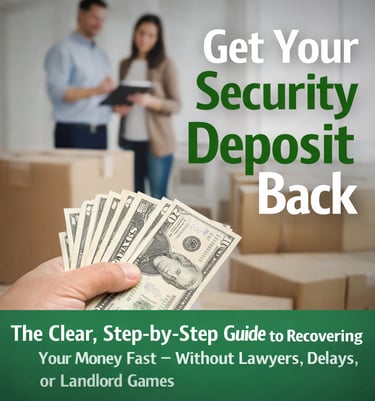
📘 Get Your Security Deposit Back shows you:
When to file (and when not to)
How to prepare in under an hour
What judges look for
Why landlords settle early
A complete step-by-step system from move-out to payment
👉 Get the complete step-by-step guide here
(Instant download • Works in all U.S. states • No lawyers required)
Help
Questions? Reach out anytime.
infoebookusa@aol.com
© 2026. All rights reserved.